The Comedown After the Glass: A November Trial on Potting-On Water-Rooted Cuttings
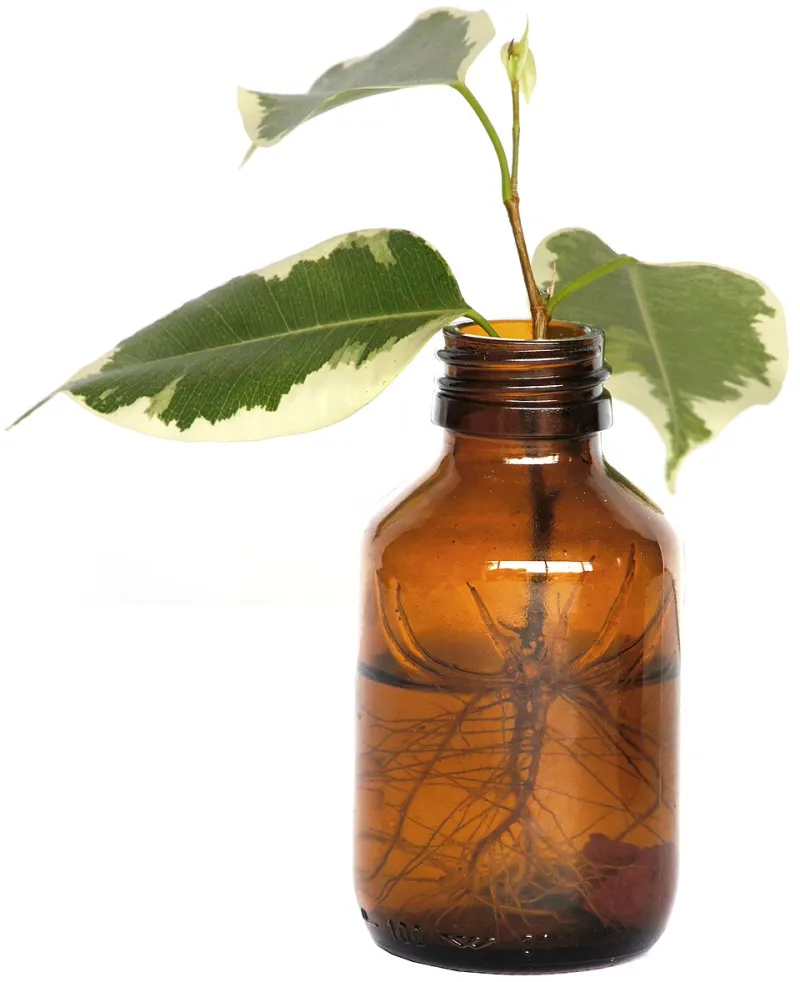
Photo: Biusch, CC BY-SA 3.0, via Wikimedia Commons
There is a particular kind of disappointment reserved for the cutting that roots beautifully in a glass on the kitchen windowsill, sits happily in water for three weeks, then sulks, droops and browns off within days of meeting compost. Nothing was obviously wrong. The roots were there. You saw them. And yet.
I have lost more cuttings at that handover than at any other stage, so this November I stopped guessing and ran the comparison properly. Thirty cuttings, two routes, one chilly north-facing windowsill in a Sheffield back bedroom.
The setup
Five easy, pithy subjects, six cuttings of each: Tradescantia zebrina, a red-leaved coleus (Solenostemon, if you insist on the old name), trailing fuchsia, a supermarket basil, and Pelargonium 'Attar of Roses'. All cut on the same morning in early November, all from stock plants on the same sill, all nodal cuttings of roughly matching length. No rooting hormone on either side, because I wanted the medium to be the only variable that mattered.
- Route A: six per species in a clean glass of tap water, water changed every third day, no feed.
- Route B: six per species in 7cm pots of a 50:50 mix of multipurpose and perlite, under a clear poly bag, bagged and unbagged alternately to keep the humidity roughly similar.
Both groups sat in the same spot, getting the same admittedly feeble November light. I checked for roots every other day and noted the first date each cutting was properly rooted — meaning roots you could see through the glass, or a gentle tug that resisted.
What actually happened
The water group rooted first, which surprised nobody. Tradescantia threw out visible roots in nine days; basil in eleven; the coleus in thirteen. The compost group ran about five to eight days behind across the board, and the pelargonium was slower than everything in both groups.
Then came the potting-on, and the numbers turned.
| Species | Water-rooted survivors (out of 6) | Compost-rooted survivors (out of 6) |
|---|---|---|
| Tradescantia | 5 | 6 |
| Coleus | 4 | 5 |
| Fuchsia | 3 | 5 |
| Basil | 2 | 4 |
| Pelargonium | 2 | 4 |
Survival here means alive and making new growth eight weeks after potting on, not merely 'not yet dead'. The water group lost the pelargonium and basil almost entirely, and the fuchsia sulked for a fortnight before two of the three survivors finally moved. In the compost group, losses were mostly down to a couple of cuttings that rotted in a too-wet mix — my fault, not the method's.
Why water roots are the softer option
This is the bit that makes the results make sense. Roots are not a single standardised product; they are built for the medium they grew into.
Roots formed in water are, quite literally, designed for a world without resistance. They are thinner-walled, less lignified, less suberised, and — crucially — they carry very few root hairs. Root hairs are the fine single-cell extensions that do the heavy lifting of water and nutrient uptake in soil, and they are expensive to build. In a glass, there is no point. Water is right there, so the plant builds a lean, cheap root system: fewer hairs, more permeable surfaces, cells that never had to push against anything.
Compost is a different proposition. It is not just 'wet' — it is a matrix with air pockets, a capillary structure, a microbial population and a nutrient load. Roots grown in it come out hairier, tougher, more subdivided, better sealed against desiccation, and colonised by fungi and bacteria that a water root has never met.
So when you lift a water-rooted cutting out of the glass, you are moving a plant that has been eating at the equivalent of a soft-food buffet into a job that requires digging. The roots snap easily, the root hairs that do exist abrade off, and the plant has to rebuild an entirely different root system while also supporting top growth. On a November windowsill with about four hours of usable light, it often simply runs out of puff.
There is a second, subtler issue: potting compost holds water at a lower availability than standing water, and it also holds less oxygen at the root zone once saturated. Roots built for a low-oxygen, high-availability environment are poorly equipped for both. They tend to sit, not grow, and a sitting root in damp compost is a rotting root.
The acclimatisation method that worked
What made a real difference in the survivors was not potting them up carefully — it was weaning them, and weaning them slowly. The three-step version that gave the best results:
1. Muddy the water. About a week before potting, stir a heaped teaspoon of the actual compost you'll be using into the glass, plus a splash of water from a pot of established plants if you have one. It sounds like superstition; it isn't. You are introducing the minerals and, more importantly, the microbes, and letting the roots begin to adapt.
2. Pot into an aggressively open mix. Half perlite, half multipurpose, or John Innes No.1 cut heavily with grit. Water roots cannot cope with dense compost while they rebuild. The airier the mix, the better the odds.
3. Keep the humidity and drop the light. Bag it or dome it for the first ten days, keep it out of direct sun, and do not feed. No tomato feed, no 'tonic'. The cutting needs to grow roots before it needs to grow leaves, and nitrogen pushes leaves.
Of the water-rooted cuttings that got this treatment, survival was noticeably better than the ones I potted straight from the glass — but still behind the compost group. Weaning narrows the gap; it does not close it.
When the glass still earns its place
I am not about to throw out the glasses. Water rooting is genuinely excellent for a specific set of plants: quick, soft, pithy things that root in ten to fourteen days and are cheap enough to replace. Tradescantia, coleus, impatiens, mint, basil, the sort of thing that will root from a snapped stem in a puddle. It is also the right call when you want to actually see what is happening, which matters more than people admit — monitoring a cutting you cannot see is how people tip out a perfectly good pot three days before it roots.
Where the glass falls down is anything woody, slow, or valuable. If a cutting takes four weeks or more to root, it is building a root system in water, not biding its time, and the potting-on shock will be correspondingly worse. Fuchsias and pelargoniums belong in compost, full stop.
The verdict
The glass is a good tool with a bad reputation for follow-through. The hangover is real, it is physiological, and it is worst in exactly the conditions most of us are propagating in right now — low light, cool sills, and a house with the heating on.
If you are going to use water, use it for the plants that forgive it, muddy the glass before you pot, and pot into something so open it looks almost wrong. Otherwise, save yourself the drama and stick it straight in the compost. Slower to root, faster to settle, and a great deal less heartbreak in January.