One Joint or Two? A Schlumbergera Rooting Race on the Winter Sill
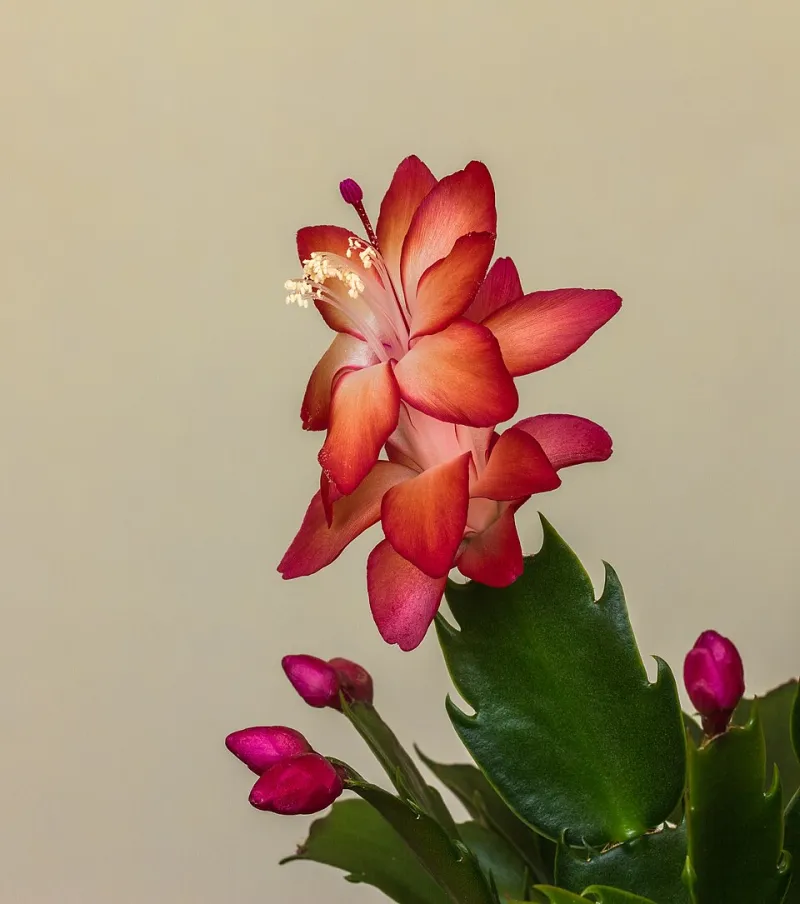
Photo: Agnes Monkelbaan, CC BY-SA 4.0, via Wikimedia Commons
Every November, somewhere in Britain, a Christmas cactus gets a haircut. The pruned segments look like small green sausages, and the temptation is to treat them like any other cutting. But Schlumbergera is an epiphytic cactus from Brazilian forest, not a hardy shrub, and its rooting rules are different. This year I set up a simple race on a windowsill: single segments against two-joint sections, same clone, same compost, same early-winter light. The question was whether longer cuttings root faster or simply rot more slowly.
Why joint count might matter
A Christmas cactus segment is a flattened cladode, not a true leaf. It stores water and carbohydrates, and it has areoles along the edges where roots and new growth can form. A two-joint cutting has more stored reserves and more potential root sites. That sounds like an advantage. It also has a larger wound at the base, more tissue to keep clean, and a bigger surface for mould to colonise in a damp propagator.
Single segments callus quickly because there is less fresh tissue to seal. Two-joint sections take a little longer to callus, but they have a buffer. If the bottom joint fails, the upper joint may still push roots. In a cold, dim UK home in November, that buffer can matter.
The race rules
I took cuttings from a healthy Schlumbergera truncata that had finished flowering. Ten single segments and ten two-joint sections, each about 8 cm and 12 cm long respectively. I left them on a saucer in a cool room for four days to callus. Then I potted them into 7 cm pots using a mix of two parts peat-free multipurpose compost to one part perlite. The pots stood on a north-east-facing windowsill above a radiator, which gave a nighttime range of 16C to 19C. Light was modest but bright enough to read a newspaper at midday.
I did not bag them. Instead I kept the compost barely moist and misted the air once a week. That is the compromise for a centrally heated home: humidity without a sealed, stagnant box. I checked for roots by gentle tug every week, and for rot at the base.
Callusing and the first roots
The single segments callused in three to four days. The two-joint sections took five to six days, and the cut ends looked fresher for longer. That is the first trade-off: longer cuttings need a little more patience before they go into compost.
Root initials appeared first on the singles. At day 12, two single segments had tiny white bumps at the base. The first two-joint section showed roots at day 15. By day 21, six singles and five doubles had visible roots. By day 35, the singles were still ahead on speed, but the doubles had caught up on reliability.
The results
At six weeks, eight of the ten two-joint cuttings had rooted, against six of the ten singles. Two singles rotted at the base; one double did. The rooted doubles also made stronger new growth, probably because they had more stored energy to draw on. The singles that rooted were perfectly fine, but they were slower to push new cladodes.
The rot pattern was instructive. The failures were all in pots that stayed wet for more than three days after watering. The singles were less forgiving because they had less tissue to lose. The doubles could sit through a slightly damp spell and still recover. That matches the general rule for Schlumbergera: it wants air at the roots, not a swamp.
What this means on a UK sill
If you have a sprawling Christmas cactus and plenty of material, take two-joint cuttings. They root more reliably, and the extra joint gives you a margin for error in a dim, heated room. If your plant is small or you are short of segments, single joints are still worth taking. Just be stricter about watering and keep them warm.
The bigger lesson is about the sill itself. A cold windowsill in November is not the same as a warm one. Schlumbergera roots best at around 18C to 21C, and it sulks below 15C. If your sill drops at night, move the pots to a brighter room or use a heat mat. And do not seal them in a bag unless you are prepared to open it daily. Christmas cactus cuttings rot in still, wet air far more often than they dry out.
For me, the two-joint section wins on reliability, not speed. The single segment is the sprint; the double is the steady plod. On a November sill in a UK home, steady usually gets there first.